How AI search started sending orders to a D2C home-décor store
A D2C home-décor store we run got 2 of its 5 orders in 30 days from ChatGPT, and its brass masala dabba moved from #10 to #1 in AI shopping search after an AEO pass across 589 products. What an AEO pass involves, and what one store's numbers can and can't tell you.
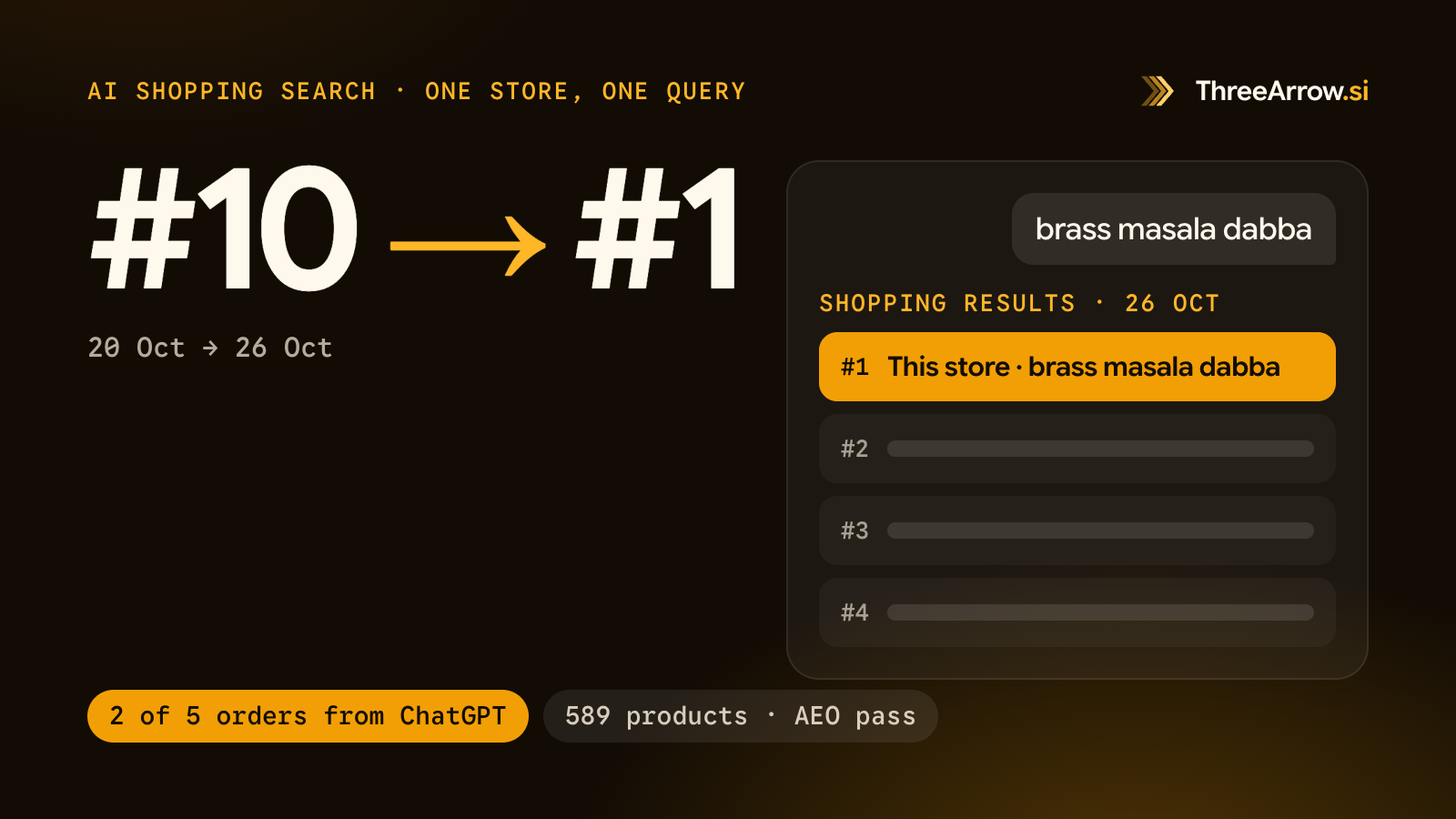
Between 20 and 26 October, a D2C home-décor store we run moved from #10 to #1 in AI shopping search for the query "brass masala dabba". The move came after an AEO (answer engine optimisation) pass across all 589 of the store's products: complete product facts, every attribute filled, structured data on each product page and one consistent description everywhere the product is listed. Over the 30 days to 25 October, 2 of the store's 5 orders came from ChatGPT.
This is one store and one query, and five orders is a small number. We're sharing it because the numbers are real, and because they're an early sign of how shoppers will find products that people describe in words, like a spice box, a lamp or a set of brass bowls.
- This store
- This store
What happened at the store?
The store is a D2C home-décor brand we run ourselves, which is why we can publish its numbers. We keep its name private.
Three facts, all from the store's own records:
- The pass. We ran an AEO pass across the whole catalogue of 589 products.
- The rank. In AI shopping search, the store's brass masala dabba ranked #10 for "brass masala dabba" on 20 October and #1 on 26 October.
- The orders. In the 30 days to 25 October, the store took 5 orders. 2 of them came from ChatGPT.
A masala dabba is a good test of AI search. Shoppers ask for it in plain words, often with a material, a size or a number of bowls in mind. An assistant answering that question needs those facts written down somewhere it can read them.
What is an AEO pass?
It's a sweep through every product so an AI assistant can read, trust and quote it. Marketplace SEO is about the words a shopper types into a search box. AEO is about the question a shopper asks an assistant, and whether your product page answers it in plain sentences.
An AEO pass, as we run it, covers four things on every product:
- Product facts. Material, size, weight, what's in the box, care, and who it suits, stated in text. A fact that sits only inside an image is hard for a crawler to read.
- Attributes. Every field the platform or feed offers gets filled: material, colour, dimensions, capacity, pack count. Shopping results and filters run on these fields, and an empty one can keep your product out of a filtered result.
- Structured data. Schema.org Product markup on each product page, with the name, price, availability, images and reviews, so a crawler can read the page as data instead of guessing from the layout.
- Consistent descriptions. The same facts on your site, your Google Merchant Center feed and every marketplace listing. If one page says 18 cm and another says 20 cm, an assistant comparing sources may repeat the wrong one or leave the product out.
The work is unglamorous. Most of it is reading what a product page already says, finding the gaps and filling them from the master sheet. On 589 products, that's the kind of job an agent does well and a person does once and never repeats.
Why would an AI assistant move a product up?
We can't say for certain, and nobody outside the AI companies can. ChatGPT, Perplexity, Claude and Google's AI answers don't publish how they choose products.
What is known is that they answer from the pages, product data and reviews they can reach. A product with complete facts in text, clean structured data and the same details on every source gives an assistant more to match against a shopper's question. A thin page gives it less.
For a query like "brass masala dabba", the match is literal. The shopper named a material and a product type. A page that states both clearly, in the title, the description and the attributes, is easy to put in front of them.
What should you not read into this?
We'd rather you trust the next number we publish, so here are the limits.
- One store, one query. We tracked "brass masala dabba". Other queries for the same store may have moved less, or not at all.
- Small numbers. Five orders in 30 days is a small sample. Two from ChatGPT is real, and it's also two.
- Two snapshots. We have the rank on 20 October and on 26 October. We don't know the path between them, and ranks in AI search shift with phrasing, location and the day you ask.
- Correlation. The rank moved after the pass. Other things change on the web every week, so we call the pass the likely cause. We can't prove it.
What we can say is that an AI assistant is already sending this store real orders, and that the work behind the rank change can be repeated on any catalogue.
How do you check where your products stand in AI search?
You can run this check yourself in an afternoon.
- Write down 20 shopper questions. Use the words customers use: material, size, use and occasion. "Brass masala dabba with 7 bowls" is a better test than your product's name.
- Ask them in ChatGPT, Perplexity, Gemini and Google's AI Mode. Note whether your product appears, at what position and which facts the answer quotes.
- Check your analytics for AI referrals. Look for sources like chatgpt.com and perplexity.ai. Count the visits and the orders.
- Check that AI search crawlers can reach you. Your robots.txt shouldn't block crawlers such as OAI-SearchBot, which ChatGPT search uses to find pages.
- Read one product page as a machine would. Can you get the size, material and price from the text alone? If the answer lives in an image, an assistant probably can't use it.
If you'd like us to do this for you, the free brand report checks how your products show up in marketplace and AI search, and you get it within 12 hours. The AI search agent then runs the pass across your catalogue: it scores each listing, fills the facts and attributes from your master sheet, adds structured data and keeps the same description on your site, your feeds and every marketplace, with your yes before anything goes live.
Questions
Which store is this?
A D2C home-décor store we run ourselves. We keep its name private, and every number in this post comes from that one store.
How do we know an order came from ChatGPT?
ChatGPT usually tags the links it sends with utm_source=chatgpt.com, so the visit and the order that follows show that source in the store's analytics. An order placed after a shopper copies the product name into a new tab won't carry the tag, so the real share can be higher than what you count.
Will an AEO pass get my products to #1?
Nobody can promise that. AI assistants don't publish how they pick products, and their answers change by phrasing, location and day. What an AEO pass does is give them complete, consistent facts to work with, which is the part you control.