How to write WhatsApp, Instagram and email retention messages for a D2C brand
Four messages bring D2C shoppers back: cart recovery, COD-to-prepaid, reorder reminders and festive campaigns. How to write each one for India and the GCC, follow WhatsApp template rules, and keep an opt-out on every marketing message.
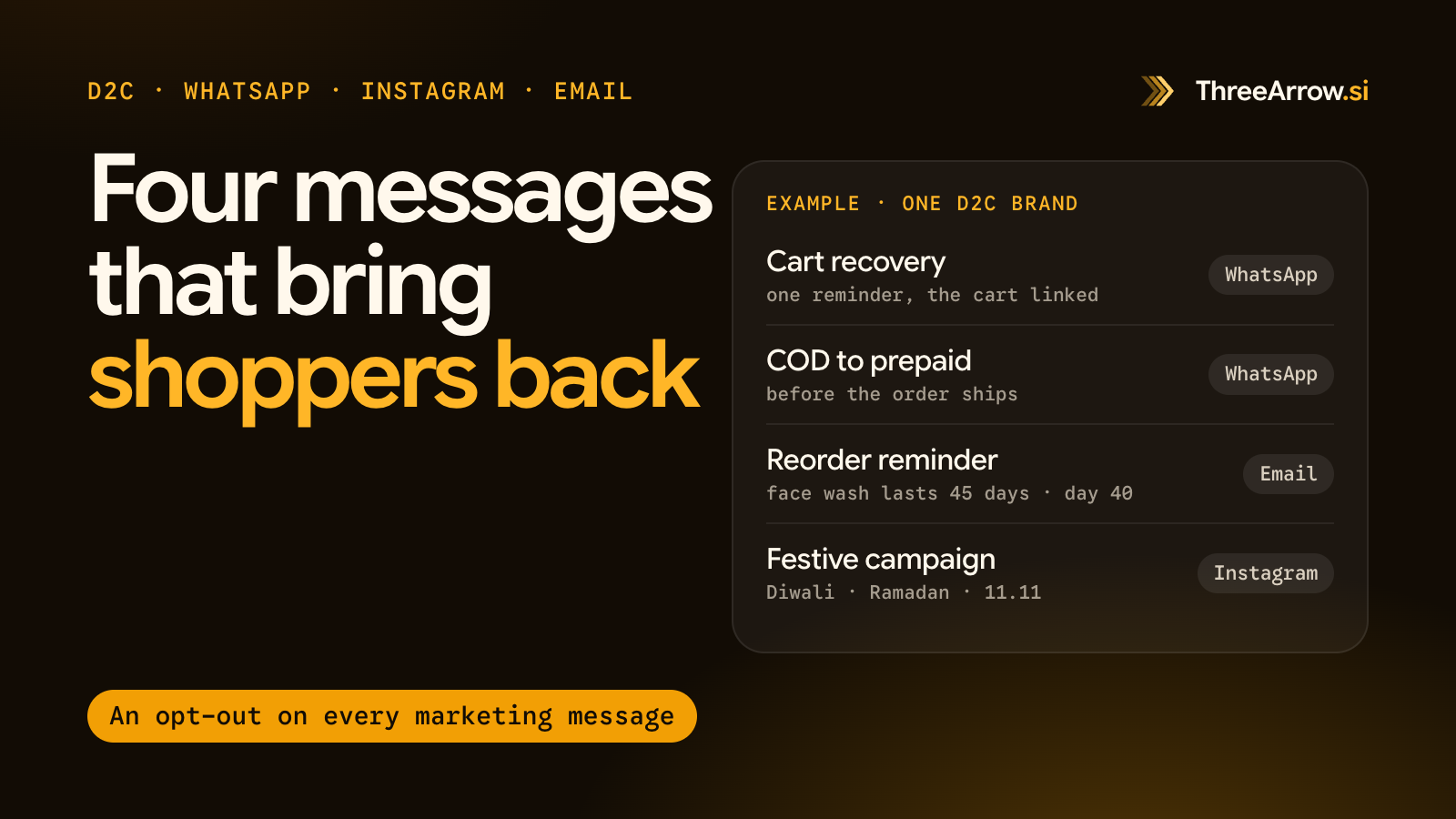
Four messages do most of a D2C brand’s retention work: cart recovery, a cash-on-delivery to prepaid nudge, reorder reminders and festive campaigns. Each needs a clear trigger, a short body with one action, real facts and offers only, and on every marketing message a way to opt out. On WhatsApp, anything your business sends first goes out as a template Meta has approved, to customers who opted in.
The writing is short. The care is in what you leave out: fake urgency, invented offers and messages to people who never said yes.
What you’ll need
- Your brand basics: tone, the words you never use, and the languages your customers read.
- The offers you actually run, with end dates. If you don’t run one, write without one.
- How long a pack lasts, for reorder reminders.
- The customer fields you hold: first name, product, order number, and a fallback for when one is missing.
- Links: cart, payment, reorder, and your support number.
- Your opt-out method: a STOP keyword, a quick-reply button or an unsubscribe link.
- A WhatsApp Business Platform account, if you send on WhatsApp.
How do you write each message?
Cart recovery
Send the first message a few hours after checkout stalls, with at most one or two follow-ups. Name the product, link straight back to the cart and offer help. Save any incentive for a later message, and only if you really run one. Never invent a stock count or a countdown.
COD to prepaid
Send it right after a cash-on-delivery order. Confirm the order, offer a payment link (UPI in India, cards and wallets across both markets), and state any real prepaid benefit, like faster dispatch, only if it’s true. Let the shopper reply to keep COD or cancel. That clear confirm or cancel step also cuts orders refused at the door. Never suggest COD is a problem.
Reorder reminder
Time it from how long the pack lasts, minus a few days for delivery. A face wash that lasts 45 days gets a reminder around day 40. Name the product, add a one-tap reorder link, and offer a way to change or stop the reminders.
Festive campaigns
Plan around the calendar your customers keep. In India: Diwali, Navratri and Durga Puja, Raksha Bandhan, Holi, Onam, Pongal, Eid and Christmas. In the GCC: Ramadan, Eid al-Fitr, Eid al-Adha, UAE National Day, Saudi National Day and White Friday. Greet the occasion properly. In Ramadan, keep the tone respectful, think about sending after iftar, and skip daytime food and drink pushes.
What are WhatsApp’s template rules, in plain words?
- Business-started messages need an approved template unless the customer messaged you in the current service window.
- Every template has a category: marketing, utility or authentication. Cart recovery, reminders and offers are marketing. A plain order update can be utility. Meta makes the final call and can reclassify.
- Marketing needs opt-in. Keep a record of when and where each customer agreed.
- Variables go in as
{{1}},{{2}}, each with a sample value. Don’t start or end the body with one, and don’t put two side by side; those templates are commonly rejected. - Add an opt-out to every marketing template: a “Stop promotions” quick-reply button or a STOP line.
Rules change, so check Meta’s current policy before you submit.
What about Instagram and email?
On Instagram, messages generally go only to people who messaged your account first, within a limited window. Use DMs for replies and the flows a shopper starts, like a story reply. Never cold DM. For festive campaigns, write the feed caption and story line too.
Email needs a short subject, a preheader, one call to action, and a footer with your contact details and a working unsubscribe link. In every channel, follow the consent and data protection rules that apply to you, such as India’s Digital Personal Data Protection Act and the UAE and Saudi data protection laws.
How do you write for India and the GCC?
Write the way your customers text. In India that can be English, Hindi or Hinglish, Hindi words in Latin script with English for product terms. In the GCC write English and clear Arabic, with Arabic punctuation and your brand name the way you spell it. Have a native speaker review Arabic before you submit it. Write prices the local way: ₹1,299 in India, AED 129 or SAR 129 in the Gulf. And keep marketing out of late nights and early mornings, local time.
Do it with the free skill
We built a free Claude skill that writes these for you: D2C retention messages. Tell Claude your brand, market, languages, real offers and the flows you want. It writes each message with its trigger and timing, WhatsApp category, template name, variables with samples, buttons and opt-out line, plus subject lines for email, in English, Hindi, Hinglish or Arabic. Anything it can’t confirm gets marked for you to check. The free skills page shows how to add it to Claude.
Common mistakes
- Fake urgency. “Only 2 left” when there are 200 costs trust you won’t get back.
- Offers that don’t exist. Every discount in a message must be one you’ll honour.
- No opt-out. Every marketing message needs one, on every channel.
- Messaging people who never opted in. It’s the fastest way to get your number flagged.
- One long message for everything. One message, one job, one button.
- Machine-literal Arabic. Get it reviewed.
Where ThreeArrow comes in
The skill writes the messages. ThreeArrow’s Marketing agent runs them on WhatsApp: it follows up abandoned carts with the shopper’s own cart, confirms COD orders before they ship, answers shoppers, messages only people who opted in, and never offers a discount you haven’t set.
Questions
Do WhatsApp marketing messages need opt-in?
Yes. Message only customers who agreed to hear from your brand on WhatsApp, keep a record of when and where they agreed, and honour opt-outs straight away.
Can we send WhatsApp messages without an approved template?
Only inside the customer service window that opens when a customer messages you. Anything your business starts outside it needs a template approved by Meta.
Does the free skill send the messages?
No. It writes the templates and copy, with variables, buttons and opt-out lines. You submit and send them through your own WhatsApp, email and Instagram tools.