Selling in Singapore and Malaysia: the marketplace stack for Indian brands
The marketplaces, fulfilment options and couriers an Indian brand needs to sell in Singapore and Malaysia, from Shopee, Lazada, TikTok Shop and Zalora to Ninja Van, J&T and SPX, and how the pieces fit together.
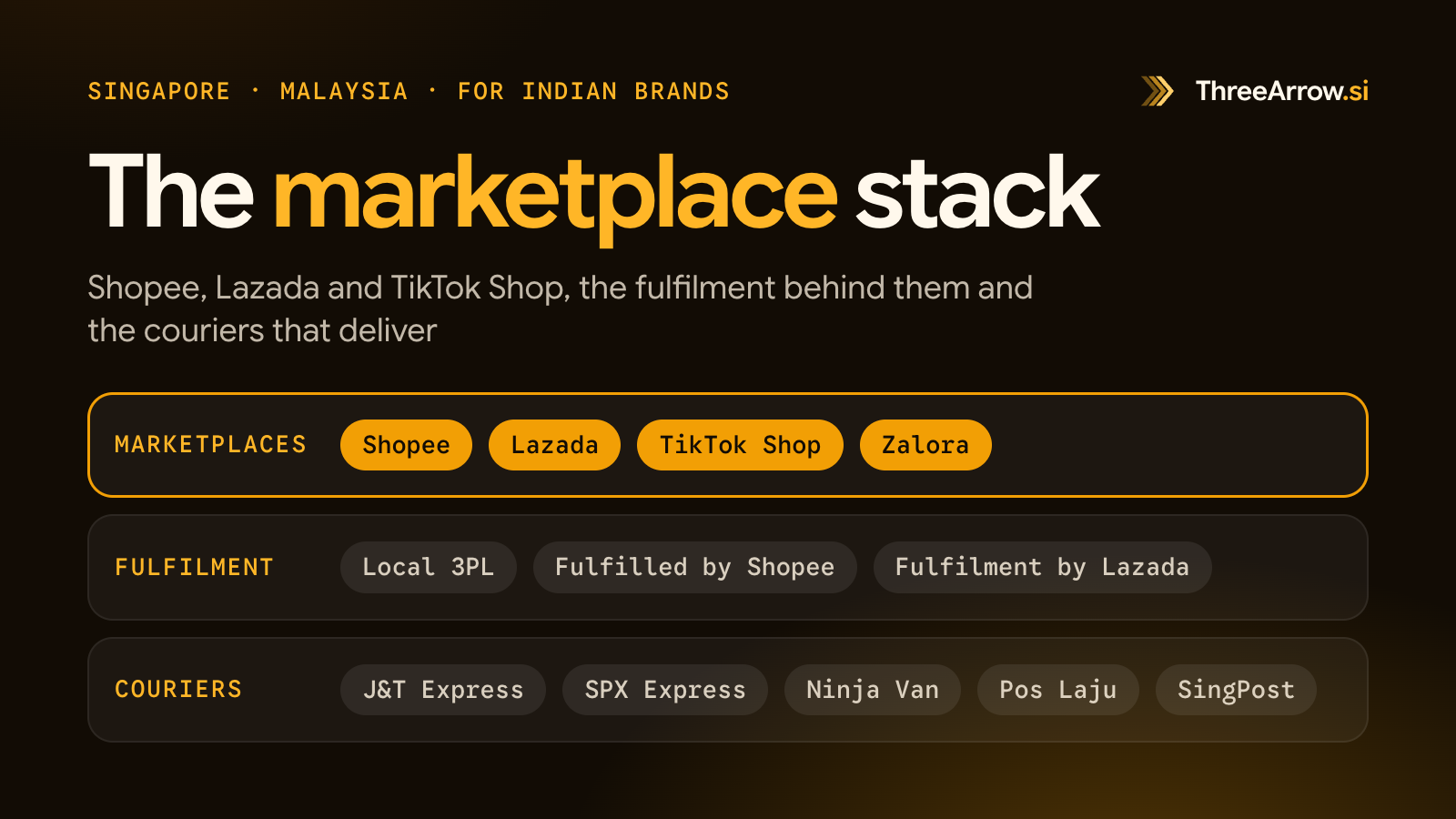
To sell in Singapore and Malaysia, most Indian brands need three marketplaces: Shopee, Lazada and TikTok Shop, which together held more than 98.8% of Southeast Asia's platform GMV in 2025, according to Momentum Works. Fashion and beauty brands add Zalora. Behind the storefronts you need stock in each country, either in a local warehouse or a marketplace's own fulfilment, and couriers to deliver: in Malaysia, J&T Express and SPX Express carry most domestic parcels, and Ninja Van covers both countries.
This is the stack as of November 2026. Market shares come from public reports and are approximate, and platform rules change often, so check each seller centre before you commit stock.
Which marketplaces matter in Singapore and Malaysia?
Three platforms take almost all the sales, and the order differs by country.
Singapore. Shopee, Lazada and TikTok Shop did about US$7.7 billion of GMV in 2025. Cube puts Shopee at 48% of that and Lazada at 22%, down from 29%. Singapore is the one market where TikTok Shop isn't second, because Lazada's brand-led LazMall holds up there.
Malaysia. Shopee leads and TikTok Shop is a strong second. Sellers usually run all three marketplaces together, often next to their own Shopify or EasyStore site.
Zalora is the fashion and beauty specialist in both countries, comparable to Myntra in India. Amazon.sg gets real traffic, about 6.8 million visits a month against about 11.9 million for Shopee.sg by Semrush's estimate, but a small share of sales.
Should you sell through an official store?
If you own the brand, yes. Shopee Mall and LazMall are the official-store tiers on Shopee and Lazada. They mark a store as the brand's own or an authorised seller, and they're where brands and distributors sell. Expect to prove you own the brand or are authorised to sell it, and usually to meet stricter rules on shipping times, returns and stock.
Official stores also run the big campaigns, like the double-date sales on 11.11 and 12.12. Those need stock in the country weeks ahead, which brings you to fulfilment.
How do you get stock into each country?
There are three routes, and you can combine them.
- A local entity or distributor. Stock is imported in bulk, cleared once and sold locally. It suits official stores and anything that needs fast delivery.
- Marketplace fulfilment. Shopee runs Fulfilled by Shopee and Lazada runs Fulfilment by Lazada in Malaysia. You send stock to their warehouse, and they pick, pack and ship. Which markets and categories qualify changes, so check the seller centre.
- A local 3PL. One warehouse that holds your stock and ships orders from Shopee, Lazada, TikTok Shop and your own site. Several 3PLs in Malaysia advertise connections to all three marketplaces.
Each platform also runs its own cross-border programme, but who can join depends on where your business is registered, so confirm whether an Indian entity qualifies before you plan around it.
Tax is part of the route you choose. Since 1 January 2023, Singapore has charged GST on imported low-value goods of S$400 or less, collected by registered overseas vendors and marketplaces at checkout. Malaysia applies its own tax to low-value goods sold online from abroad. Check the current thresholds with IRAS and the Royal Malaysian Customs Department, or with a local adviser.
Which couriers deliver the orders?
On marketplace orders, the platform usually offers its own set of integrated carriers, so much of the choice happens in its logistics settings. You still need to know who's carrying your parcels, because their scans are your tracking.
Malaysia. J&T Express and SPX Express, Shopee's own carrier, carried about 73.5% of domestic parcels in late 2025, according to Lowyat and WePost. Ninja Van, Pos Malaysia's Pos Laju and City-Link Express make up most of the rest, and GDEX is mostly B2B. Flash Express shut its Malaysian operations at the end of January 2026, and the platforms moved its sellers to other carriers.
Singapore. SingPost, with its POPStation lockers, Ninja Van and J&T, plus the marketplaces' own fleets: SPX for Shopee and LEX for Lazada. Lalamove and GrabExpress cover same-day and on-demand delivery.
Between the two. DHL eCommerce and Pos Laju International carry parcels between Malaysia and Singapore.
Is there quick commerce in Singapore and Malaysia?
Yes, and it sits inside the bigger apps. RedMart, Lazada's grocery arm, is Singapore's main online grocer, and it launched 30-minute delivery as RedMart Now in February 2026. foodpanda's pandamart runs dark stores in both countries, and GrabMart delivers groceries in both. In Malaysia, Shopee runs Shopee Instant Mart through ShopeeFood.
For an FMCG or personal-care brand used to Blinkit and Zepto, these are the closest equivalents. They work through their own vendor and supply terms, so treat them as a second step after the marketplaces.
What does running this stack take each day?
The same jobs as in India, on different portals. Listings in four marketplace formats. Stock synced across Shopee, Lazada, TikTok Shop and your own site, so a campaign doesn't sell units you don't have. Orders shipped on time to keep seller ratings up. Settlements checked against each platform's fees.
Malaysian sellers often run this through a multichannel OMS like SiteGiant, BigSeller or Ginee, and larger brands in Singapore use Anchanto. Our agents work on top of whichever you use. Every marketplace and courier in this post is on our integrations page, and the catalog, stock and marketplace orders agents run the listing, stock and order jobs across them, with your yes before anything changes price or reaches a customer.
To see where your products would stand against local rivals on Shopee and Lazada before you ship a carton, ask for a free brand report.
Questions
Can we sell from India without a company in Singapore or Malaysia?
Sometimes. Each marketplace runs its own cross-border seller programme, and who can join depends on where your business is registered and what you sell. Many brands sell through a local entity or a distributor instead, which also makes official stores, returns and local delivery simpler. Check each platform's current rules before you plan stock.
Is Amazon worth it in Singapore?
It's a small share of Singapore's marketplace sales, but it runs on the same Seller Central as Amazon.in and Amazon.ae. If you already sell on Amazon, adding Amazon.sg costs little. It shouldn't come before Shopee or Lazada.
Do we need a different catalog for each marketplace?
You need a different template for each, from the same product facts. Shopee, Lazada, TikTok Shop and Zalora each have their own category tree, attributes and image rules, so one master sheet filled into each template is the way to keep them consistent.